
Pokémon
Gengar
Gengar is a round purple ghost with red eyes and a wide grin, and it is the Pokémon that looks most like a Halloween decoration. It appeared in Pokémon Red and Green in 1996 as the final form of the Gastly line, and it only evolves when traded to another player, which made it a status symbol among children with a link cable.
- First appearance
- Pokémon Red and Green (1996), Game Freak / Nintendo
- Created by
- Ken Sugimori, Game Freak
- Universe
- Pokémon
- Appears in
- games, animation, television
Who is Gengar?
Gengar is a round purple ghost with red eyes and a wide grin, and it is the Pokémon that looks most like a Halloween decoration. It appeared in Pokémon Red and Green in 1996 as the final form of the Gastly line, and it only evolves when traded to another player, which made it a status symbol among children with a link cable. Its name is generally read as a shortening of doppelgänger, and its Pokédex entries cast it as a shadow that follows people. Game Freak made it mischievous rather than frightening, which is why it sits comfortably on children's clothing in October and on adult clothing the rest of the year.
Gengar: the details
- Debut
- The original Game Boy titles, released in Japan in 1996 as Red and Green
- National Pokédex
- Entry 094, the last of three ghost stages after Gastly and Haunter
- Typing
- Ghost, with Poison as its second type
- A trade-only evolution
- Haunter becomes Gengar only after being traded to another player
- Where the name comes from
- Generally read as a shortening of doppelgänger
- What the games say about it
- It hides in shadows and follows people, according to its Pokédex entries
Why Gengar endures
The first generation's favourite ghost, and a Pokémon that works as Halloween wear for every age.
What Gengar looks like on a shirt
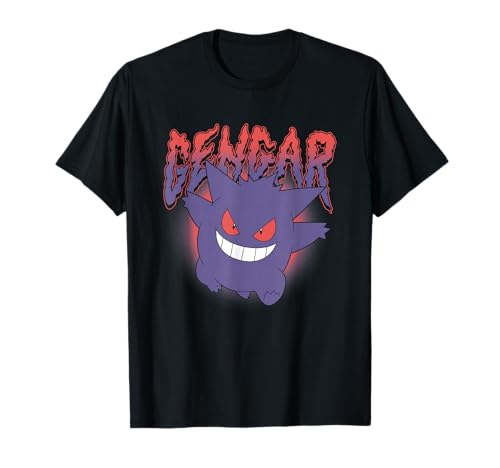
Signature motif: Round purple silhouette with spikes, red eyes and a toothy grin
The grin alone identifies it. Purple needs a black or dark grey ground; glow-in-the-dark and Halloween prints are common.
A strong October seller for every age. The grin alone makes a minimal adult design; glow-in-the-dark prints are common.
Gengar T-shirts
See all on Amazon →
Pokémon
Gastly Gengar Hunter Forest T-Shirt
$19.99on amazon.com · Sep 16, 2026
Check sizes and price on Amazon

Pokémon
Pokémon Gengar Ghost Type 0094 Spooky Poster T-Shirt
$19.99on amazon.com · Sep 16, 2026
Check sizes and price on Amazon

Pokémon
Pokemon Gengar Big Face Outline T-Shirt
$19.99on amazon.com · Sep 16, 2026
Check sizes and price on Amazon

Pokémon
Pokémon Gengar 0094 Multiple Faces Vintage Poster T-Shirt
$19.99on amazon.com · Sep 16, 2026
Check sizes and price on Amazon


Pokémon
Gengar Pastel Stats Grid T-Shirt
$19.99on amazon.com · Sep 16, 2026
Check sizes and price on Amazon
Pokémon
Pokémon Gengar Running Creepy Logo T-Shirt
$19.99on amazon.com · Sep 16, 2026
Check sizes and price on Amazon
Buying from outside the United States? Prices shown are amazon.com in US dollars. Links redirect international readers to their local Amazon, where pricing, sizing and availability are shown in local terms.
Price and availability are taken from Amazon at the time shown and can change. The price on Amazon at the time of purchase applies.
Sizes: kids to adult
These links run a live Amazon search for Gengar shirts in each US size band. Amazon shows what is currently listed; availability in a particular size is confirmed on the product page, not here.
| Band | Ages | US sizes | Search |
|---|---|---|---|
| Toddler | 2–4 years | 2T, 3T, 4T | Search toddler sizes |
| Kids | 4–7 years | XS (4/5), S (6/7) | Search kids sizes |
| Youth | 8–14 years | M (8), L (10/12), XL (14/16) | Search youth sizes |
| Adult | 15+ | S–3XL | Search adult sizes |
US sizing shown. Cut and measurement vary between brands — see the size guide before ordering, especially for youth sizes. Base search: Gengar t-shirt.
More from Pokémon
All Pokémon →More anime & manga
All anime & manga →Gengar T-shirts: common questions
Who created Gengar?
Gengar was created by Ken Sugimori and Game Freak, first appearing in Pokémon Red and Green in 1996 (Game Freak / Nintendo).
What does a Gengar T-shirt usually look like?
Round purple silhouette with spikes, red eyes and a toothy grin. A strong October seller for every age. The grin alone makes a minimal adult design; glow-in-the-dark prints are common.
Are Gengar T-shirts made for children?
Yes — Gengar appears on our kids pages, and shirts are commonly made from US toddler 2T up through youth XL.
How much does a Gengar T-shirt cost?
Gengar shirts we currently track start from around $19.99 on amazon.com. Every price on this page is dated, because they move.
This profile was compiled from published reference material about Gengar — first appearance, creator credits and production history — and is a secondary source rather than a substitute for the original publication. Where a detail could not be corroborated it has been left out. We do not physically test garments; see how we work for what that means and what it does not.
Reference. This profile was compiled from published sources. For the character's full publication history see Wikipedia (Wikidata Q2250743). Our method and limitations are stated in full.
CharacterTshirts.com is an independent guide. It is not affiliated with, authorized by, endorsed by, or connected to any character rights holder, publisher, studio or network named on this site. All character names and titles are trademarks of their respective owners and are used here only to identify the products described.