Popfunk
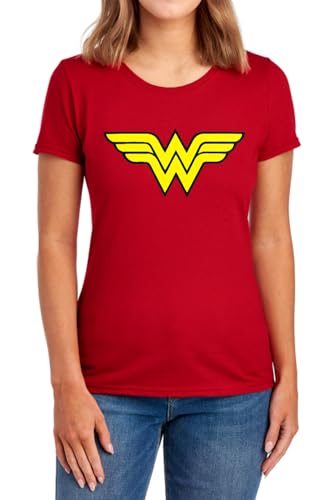
Popfunk Wonder Woman Logo Women's Halloween Costume T-Shirt Red MD
$17.99on amazon.com · Sep 29, 2026
Check sizes and price on Amazon
DC Comics
Wonder Woman was created with an explicit political thesis, which makes her unusual among superheroes. William Moulton Marston — a psychologist who worked on early lie-detection research — argued in print that comics needed a heroine who won through love and truth rather than force, and built an Amazonian warrior to prove it.
Wonder Woman was created with an explicit political thesis, which makes her unusual among superheroes. William Moulton Marston — a psychologist who worked on early lie-detection research — argued in print that comics needed a heroine who won through love and truth rather than force, and built an Amazonian warrior to prove it. The results are stranger and more interesting than the sanitised version suggests: the early strips are dense with bondage imagery, matriarchal politics and Marston's own theories about submission to loving authority. After his death the character drifted for decades, at one point losing her powers entirely to become a mod boutique owner, before George Pérez's 1987 relaunch rebuilt her around Greek mythology and diplomacy. She is now the fixed third point of DC's trinity with Batman and Superman, and the most widely recognised female superhero in any medium.
The longest continuously published female superhero, and for much of that time the only one with real cultural reach. Her emblem was adopted by the feminist movement in the 1970s — Ms. magazine put her on its first cover in 1972 — which is a level of political adoption almost no other licensed character has achieved.
Signature motif: The double-W eagle emblem, the tiara, and the golden lasso
The chest emblem began as a stylised eagle and was redrawn in the 1982 as the twin-W shape most people now recognise. On apparel the WW mark and the red-blue-gold palette do most of the work; the tiara star is a common secondary motif.
Shirts divide between the modern WW badge in gold on red, the full 1970s costume-style print associated with Lynda Carter, and the armoured film look. The gold-on-red badge is the most versatile and the most common in youth sizing.


Buying from outside the United States? Prices shown are amazon.com in US dollars. Links redirect international readers to their local Amazon, where pricing, sizing and availability are shown in local terms.
Price and availability are taken from Amazon at the time shown and can change. The price on Amazon at the time of purchase applies.
These links run a live Amazon search for Wonder Woman shirts in each US size band. Amazon shows what is currently listed; availability in a particular size is confirmed on the product page, not here.
| Band | Ages | US sizes | Search |
|---|---|---|---|
| Toddler | 2–4 years | 2T, 3T, 4T | Search toddler sizes |
| Kids | 4–7 years | XS (4/5), S (6/7) | Search kids sizes |
| Youth | 8–14 years | M (8), L (10/12), XL (14/16) | Search youth sizes |
| Adult | 15+ | S–3XL | Search adult sizes |
US sizing shown. Cut and measurement vary between brands — see the size guide before ordering, especially for youth sizes. Base search: Wonder Woman t-shirt.
| Performer | Production | Year | Type |
|---|---|---|---|
| Lynda Carter | Wonder Woman | 1975 | live-action |
| Gal Gadot | Batman v Superman: Dawn of Justice | 2016 | live-action |
| Susan Eisenberg | Justice League | 2001 | Voice |
Wonder Woman was created by William Moulton Marston and Harry G. Peter, first appearing in All Star Comics #8 in 1941 (DC Comics).
The double-W eagle emblem, the tiara, and the golden lasso. Shirts divide between the modern WW badge in gold on red, the full 1970s costume-style print associated with Lynda Carter, and the armoured film look. The gold-on-red badge is the most versatile and the most common in youth sizing.
Yes — Wonder Woman appears on our kids pages, and shirts are commonly made from US toddler 2T up through youth XL.
Wonder Woman has been played on screen by Lynda Carter (Wonder Woman, 1975), Gal Gadot (Batman v Superman: Dawn of Justice, 2016), and voiced by Susan Eisenberg (Justice League, 2001).
Wonder Woman shirts we currently track start from around $10.97 on amazon.com. Every price on this page is dated, because they move.
This profile was compiled from published reference material about Wonder Woman — first appearance, creator credits and production history — and is a secondary source rather than a substitute for the original publication. Where a detail could not be corroborated it has been left out. We do not physically test garments; see how we work for what that means and what it does not.
Reference. This profile was compiled from published sources. For the character's full publication history see Wikipedia (Wikidata Q8031783). Our method and limitations are stated in full.
CharacterTshirts.com is an independent guide. It is not affiliated with, authorized by, endorsed by, or connected to any character rights holder, publisher, studio or network named on this site. All character names and titles are trademarks of their respective owners and are used here only to identify the products described.