SEGA
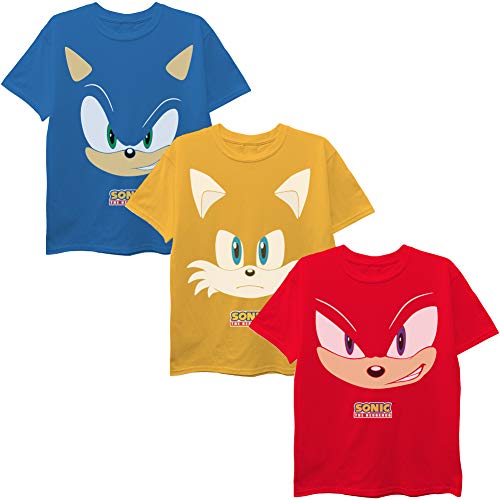
SEGA boys Sonic the Hedgehog 3-pack T-shirt Bundle, Sonic, Tails, Knuckles T Shirt, Gold/Red/Royal Blue, 8 10 US
$18.36on amazon.com · Sep 29, 2026
Check sizes and price on Amazon
Sega
Sonic was engineered as a competitor. Sega needed a mascot to set against Mario and ran an internal contest; Naoto Ohshima's hedgehog won, and the brief that shaped him was explicitly oppositional — where Mario was round, friendly and methodical, Sonic would be sharp, impatient and fast.
Sonic was engineered as a competitor. Sega needed a mascot to set against Mario and ran an internal contest; Naoto Ohshima's hedgehog won, and the brief that shaped him was explicitly oppositional — where Mario was round, friendly and methodical, Sonic would be sharp, impatient and fast. The colour was chosen to match Sega's corporate blue, the shoes were inspired by Michael Jackson's boots crossed with Santa Claus's, and the attitude was a calculated read on early-1990s American marketing. It worked completely: Sonic the Hedgehog outsold expectations, established the Mega Drive in the United States, and produced the only sustained challenge Nintendo's mascot has faced. The character's later decades have been rockier, but the 2020 film's response to fan criticism of its original design — a full, expensive redesign before release — became a landmark moment in audience influence over production.
The only mascot to seriously challenge Mario, and the character that established Sega in North America. The 2020 film redesign is also the most-cited example of audience feedback forcing a major production change before release.
Signature motif: Blue quills, red-and-white shoes, and the gold ring
The spiked-quill silhouette and the gold ring are both strong independent marks. The ring in particular is a clean single-object graphic that carries the franchise with no character present, which is unusual and useful.
The quill silhouette works as a bold single-colour shape, and the gold ring is a strong standalone graphic. Blue garments are obvious but the character reads better on black and white. Retro 16-bit pixel treatments are historically grounded and popular with adults.


Buying from outside the United States? Prices shown are amazon.com in US dollars. Links redirect international readers to their local Amazon, where pricing, sizing and availability are shown in local terms.
Price and availability are taken from Amazon at the time shown and can change. The price on Amazon at the time of purchase applies.
These links run a live Amazon search for Sonic the Hedgehog shirts in each US size band. Amazon shows what is currently listed; availability in a particular size is confirmed on the product page, not here.
| Band | Ages | US sizes | Search |
|---|---|---|---|
| Toddler | 2–4 years | 2T, 3T, 4T | Search toddler sizes |
| Kids | 4–7 years | XS (4/5), S (6/7) | Search kids sizes |
| Youth | 8–14 years | M (8), L (10/12), XL (14/16) | Search youth sizes |
| Adult | 15+ | S–3XL | Search adult sizes |
US sizing shown. Cut and measurement vary between brands — see the size guide before ordering, especially for youth sizes. Base search: Sonic the Hedgehog t-shirt.
| Performer | Production | Year | Type |
|---|---|---|---|
| Ben Schwartz | Sonic the Hedgehog | 2020 | Voice |
| Roger Craig Smith | Sonic Colors | 2010 | Voice |
Sonic the Hedgehog was created by Naoto Ohshima and Yuji Naka and Hirokazu Yasuhara, first appearing in Sonic the Hedgehog in 1991 (Sega).
Blue quills, red-and-white shoes, and the gold ring. The quill silhouette works as a bold single-colour shape, and the gold ring is a strong standalone graphic. Blue garments are obvious but the character reads better on black and white. Retro 16-bit pixel treatments are historically grounded and popular with adults.
Yes — Sonic the Hedgehog appears on our kids pages, and shirts are commonly made from US toddler 2T up through youth XL.
Sonic the Hedgehog has been voiced by Ben Schwartz (Sonic the Hedgehog, 2020), Roger Craig Smith (Sonic Colors, 2010).
Sonic the Hedgehog shirts we currently track start from around $11.81 on amazon.com. Every price on this page is dated, because they move.
This profile was compiled from published reference material about Sonic the Hedgehog — first appearance, creator credits and production history — and is a secondary source rather than a substitute for the original publication. Where a detail could not be corroborated it has been left out. We do not physically test garments; see how we work for what that means and what it does not.
Reference. This profile was compiled from published sources. For the character's full publication history see Wikipedia (Wikidata Q191626). Our method and limitations are stated in full.
CharacterTshirts.com is an independent guide. It is not affiliated with, authorized by, endorsed by, or connected to any character rights holder, publisher, studio or network named on this site. All character names and titles are trademarks of their respective owners and are used here only to identify the products described.