
Marvel Comics
Loki
Loki is the most successful redemption-adjacent villain Marvel has, and the reason is that he is never quite redeemed. The character works because his grievance is legitimate — he is a stolen child raised as a spare, told he was a prince and discovering he was a hostage — and because he responds to it in ways that are consistently petty rather than tragic.
- First appearance
- Venus #6 (1949), Timely Comics
- Created by
- Stan Lee, Larry Lieber, Jack Kirby
- Also known as
- Loki Laufeyson, The God of Mischief, The Trickster
- Universe
- Marvel Universe
- Appears in
- comics, film, television, animation, games
Who is Loki?
Loki is the most successful redemption-adjacent villain Marvel has, and the reason is that he is never quite redeemed. The character works because his grievance is legitimate — he is a stolen child raised as a spare, told he was a prince and discovering he was a hostage — and because he responds to it in ways that are consistently petty rather than tragic. That combination, real hurt expressed through pointless mischief, is what separates him from the operatic villains around him. The Norse source is more ambivalent still: in the Eddas Loki is neither straightforwardly good nor evil but a necessary agitator, the one who causes the problem and then solves it. Marvel's version has drifted steadily toward that reading, and the character's shapeshifting has been used in recent work to make his gender and form explicitly fluid, which is faithful to the mythology rather than a departure from it.
Loki: the details
- First appearance
- Venus #6, August 1949, though the Marvel Universe version dates from Journey into Mystery #85, 1962
- Created by
- The modern character by Stan Lee, Larry Lieber and Jack Kirby; adapted from Norse mythology
- Adopted, not born
- A Frost Giant infant taken by Odin after a war — the discovery of which drives most of his motivation
- Mythological ambivalence
- In the Eddas he is neither hero nor villain but an agitator who causes and then resolves problems
- Shapeshifting
- Attested in Norse myth, where Loki takes both animal and female forms and bears children — Marvel's fluid depiction follows the source
- Not Thor's blood brother
- The sworn-brother relationship is Marvel's framing; the Eddas make him Odin's blood brother instead
- Own series
- A live-action television series from 2021 that centres him rather than Thor
Why Loki endures
The Marvel antagonist with the most durable independent following, and the character through which the studio first demonstrated that a villain could headline his own long-form series. His treatment is also among the most prominent mainstream depictions of a gender-fluid character.
What Loki looks like on a shirt
Signature motif: The horned golden helm, green and gold cape
The curved twin-horned helmet is the graphic, and it is a genuinely good one — an abstract silhouette that reads instantly and works in a single colour. Green and gold is a distinctive pairing in a Marvel line otherwise dominated by primary red and blue.
The horned helm is the mark and needs nothing else — strong in single-colour gold on black or green. Green and gold reads distinctly against the rest of the Marvel line. Skews teen and adult; the helmet silhouette also works well as a small chest print.
Loki T-shirts
See all on Amazon →
Marvel
Marvel - Loki Master of Mischief T-Shirt
$22.99on amazon.com · Sep 29, 2026
Check sizes and price on Amazon

Marvel
Marvel Loki Series Icon T-Shirt
$19.99on amazon.com · Sep 29, 2026
Check sizes and price on Amazon
Marvel
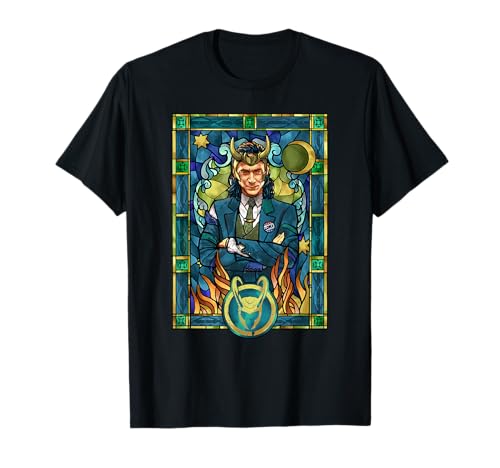
Marvel Loki Stained Glass Portrait T-Shirt
$19.99on amazon.com · Sep 29, 2026
Check sizes and price on Amazon

Marvel
Marvel Loki Time Variance Authority TVA Timeline T-Shirt
$19.99on amazon.com · Sep 29, 2026
Check sizes and price on Amazon

Marvel
Marvel Loki Split Face Loki Logo Stack T-Shirt
$19.99on amazon.com · Sep 29, 2026
Check sizes and price on Amazon
Marvel
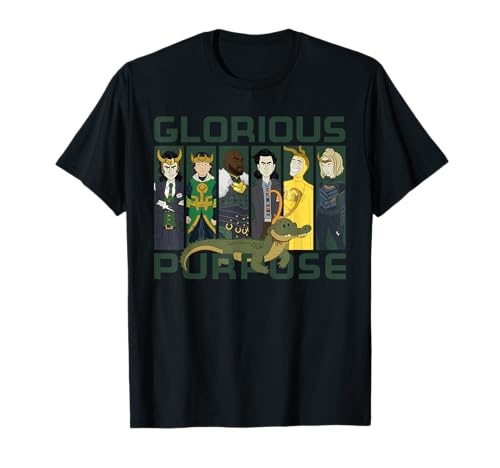
Marvel Loki Variants Alligator Loki Glorious Purpose T-Shirt Small
$19.99on amazon.com · Sep 29, 2026
Check sizes and price on Amazon

Marvel
Marvel Loki Alligator Loki and Book Glorious Purpose T-Shirt
$19.99on amazon.com · Sep 29, 2026
Check sizes and price on Amazon
Buying from outside the United States? Prices shown are amazon.com in US dollars. Links redirect international readers to their local Amazon, where pricing, sizing and availability are shown in local terms.
Price and availability are taken from Amazon at the time shown and can change. The price on Amazon at the time of purchase applies.
Sizes: kids to adult
These links run a live Amazon search for Loki shirts in each US size band. Amazon shows what is currently listed; availability in a particular size is confirmed on the product page, not here.
| Band | Ages | US sizes | Search |
|---|---|---|---|
| Toddler | 2–4 years | 2T, 3T, 4T | Search toddler sizes |
| Kids | 4–7 years | XS (4/5), S (6/7) | Search kids sizes |
| Youth | 8–14 years | M (8), L (10/12), XL (14/16) | Search youth sizes |
| Adult | 15+ | S–3XL | Search adult sizes |
US sizing shown. Cut and measurement vary between brands — see the size guide before ordering, especially for youth sizes. Base search: Loki t-shirt Marvel.
Who has played Loki
| Performer | Production | Year | Type |
|---|---|---|---|
| Tom Hiddleston | Thor | 2011 | live-action |
| Sophia Di Martino | Loki | 2021 | live-action |
More from Marvel Comics
All Marvel Comics →More superheroes
All superheroes →Loki T-shirts: common questions
Who created Loki?
Loki was created by Stan Lee and Larry Lieber and Jack Kirby, first appearing in Venus #6 in 1949 (Timely Comics).
What does a Loki T-shirt usually look like?
The horned golden helm, green and gold cape. The horned helm is the mark and needs nothing else — strong in single-colour gold on black or green. Green and gold reads distinctly against the rest of the Marvel line. Skews teen and adult; the helmet silhouette also works well as a small chest print.
Are Loki T-shirts made for children?
No. Loki comes from work made for older audiences, so we keep the character off our kids pages even where children's sizes are manufactured.
Who has played Loki?
Loki has been played on screen by Tom Hiddleston (Thor, 2011), Sophia Di Martino (Loki, 2021).
How much does a Loki T-shirt cost?
Loki shirts we currently track start from around $19.99 on amazon.com. Every price on this page is dated, because they move.
This profile was compiled from published reference material about Loki — first appearance, creator credits and production history — and is a secondary source rather than a substitute for the original publication. Where a detail could not be corroborated it has been left out. We do not physically test garments; see how we work for what that means and what it does not.
Reference. This profile was compiled from published sources. For the character's full publication history see Wikipedia (Wikidata Q1147326). Our method and limitations are stated in full.
CharacterTshirts.com is an independent guide. It is not affiliated with, authorized by, endorsed by, or connected to any character rights holder, publisher, studio or network named on this site. All character names and titles are trademarks of their respective owners and are used here only to identify the products described.