
Scooby-Doo!
Scooby-Doo Mystery Incorporated Scary House Movie Poster T-Shirt
$16.99on amazon.com · Sep 29, 2026
Check sizes and price on Amazon
Hanna-Barbera
Scooby-Doo was built to survive censorship. American children's television in the late 1960s was under sustained pressure over violence, and CBS wanted a non-violent adventure format; the answer was a mystery show where the monster is always a person in a costume with a financial motive, so nothing supernatural is ever endorsed and nobody is ever hurt.
Scooby-Doo was built to survive censorship. American children's television in the late 1960s was under sustained pressure over violence, and CBS wanted a non-violent adventure format; the answer was a mystery show where the monster is always a person in a costume with a financial motive, so nothing supernatural is ever endorsed and nobody is ever hurt. That formula is remarkably rigid and has proved almost infinitely repeatable across five decades of continuous production. Iwao Takamoto designed the dog by consulting a Great Dane breeder and then deliberately violating every breed standard he was told about — sloped back, bowed legs, small chin — so the character would read as comic rather than handsome. The show's sceptical structure, in which every apparent haunting has a mundane explanation, is genuinely unusual in children's media.
One of the longest continuously produced animated franchises in television history, and a rare children's property built on a consistently sceptical premise — every supernatural event has a mundane, human explanation.
Signature motif: A brown Great Dane with black spots and a blue collar with an SD tag
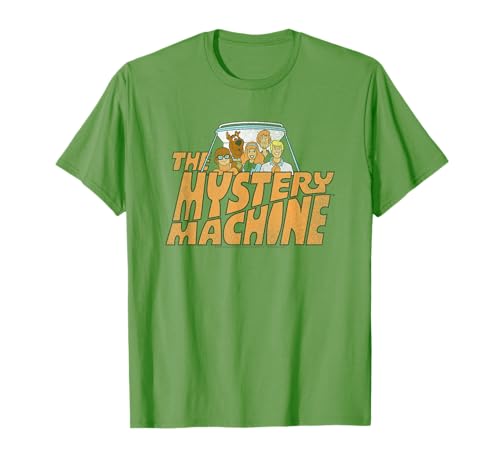
The Mystery Machine van is as strong a graphic as the dog — a green and blue flower-decorated panel van that carries a design on its own. The 1970s palette of orange, green and brown is instantly period-identifying.
The Mystery Machine is as commercially useful as the character and works as a standalone graphic. The 1970s orange-green-brown palette is strongly period-identifying and popular with adults. Very strong retro and vintage-styled treatments.



Buying from outside the United States? Prices shown are amazon.com in US dollars. Links redirect international readers to their local Amazon, where pricing, sizing and availability are shown in local terms.
Price and availability are taken from Amazon at the time shown and can change. The price on Amazon at the time of purchase applies.
These links run a live Amazon search for Scooby-Doo shirts in each US size band. Amazon shows what is currently listed; availability in a particular size is confirmed on the product page, not here.
| Band | Ages | US sizes | Search |
|---|---|---|---|
| Toddler | 2–4 years | 2T, 3T, 4T | Search toddler sizes |
| Kids | 4–7 years | XS (4/5), S (6/7) | Search kids sizes |
| Youth | 8–14 years | M (8), L (10/12), XL (14/16) | Search youth sizes |
| Adult | 15+ | S–3XL | Search adult sizes |
US sizing shown. Cut and measurement vary between brands — see the size guide before ordering, especially for youth sizes. Base search: Scooby Doo t-shirt.
| Performer | Production | Year | Type |
|---|---|---|---|
| Don Messick | Scooby-Doo, Where Are You! | 1969 | Voice |
| Frank Welker | What's New, Scooby-Doo? | 2002 | Voice |
Scooby-Doo was created by Joe Ruby and Ken Spears and Iwao Takamoto, first appearing in Scooby-Doo, Where Are You! in 1969 (Hanna-Barbera).
A brown Great Dane with black spots and a blue collar with an SD tag. The Mystery Machine is as commercially useful as the character and works as a standalone graphic. The 1970s orange-green-brown palette is strongly period-identifying and popular with adults. Very strong retro and vintage-styled treatments.
Yes — Scooby-Doo appears on our kids pages, and shirts are commonly made from US toddler 2T up through youth XL.
Scooby-Doo has been voiced by Don Messick (Scooby-Doo, Where Are You!, 1969), Frank Welker (What's New, Scooby-Doo?, 2002).
Scooby-Doo shirts we currently track start from around $11.80 on amazon.com. Every price on this page is dated, because they move.
This profile was compiled from published reference material about Scooby-Doo — first appearance, creator credits and production history — and is a secondary source rather than a substitute for the original publication. Where a detail could not be corroborated it has been left out. We do not physically test garments; see how we work for what that means and what it does not.
Reference. This profile was compiled from published sources. For the character's full publication history see Wikipedia (Wikidata Q901323). Our method and limitations are stated in full.
CharacterTshirts.com is an independent guide. It is not affiliated with, authorized by, endorsed by, or connected to any character rights holder, publisher, studio or network named on this site. All character names and titles are trademarks of their respective owners and are used here only to identify the products described.