
Mademark
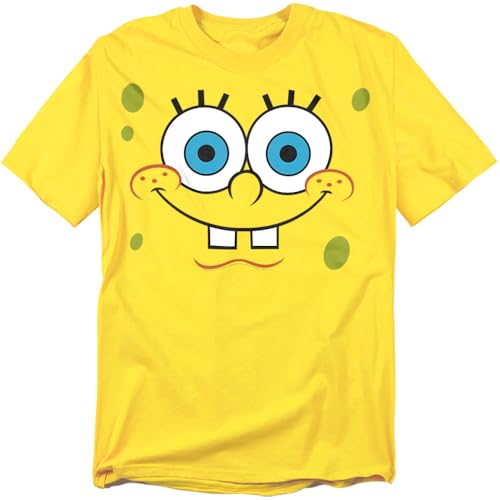
Spongebob Squarepants It's the Best Day Ever! T-Shirt
$16.14on amazon.com · Sep 29, 2026
Check sizes and price on Amazon
Television Animation
SpongeBob shirts are bought by two very different groups: children who watch the show now, and adults who grew up with it since 1999. Most listings here cover both, and several include big and tall and plus sizes.
Pick the age group, then choose between a classic face and a line from the show.
US 2T–4T
6 of the 8 shirts below are listed in toddler sizes on Amazon (checked Sep 29, 2026).
Check toddler sizes and prices on AmazonUS XS (4/5) – XL (14/16)
6 of the 8 shirts below are listed in kids & youth sizes on Amazon (checked Sep 29, 2026).
Check kids & youth sizes and prices on AmazonUS S–XL, most listings unisex
7 of the 8 shirts below are listed in adult sizes on Amazon (checked Sep 29, 2026).
Check adult sizes and prices on AmazonListings offered in Men’s Big and Tall, Women’s Plus, 3XL and above, or tall sizes.
7 of the 8 shirts below are listed this way (checked Sep 29, 2026), including:
Adult and children’s sizes offered on the same product page — the simplest way to put together a matching set. Some ranges use a different character per family member, so check the design menu.
5 of the 8 shirts below are listed this way (checked Sep 29, 2026), including:




Price and availability are taken from Amazon at the time shown and can change. The price on Amazon at the time of purchase applies.
Details are taken from each Amazon listing and Amazon’s size data on the date shown. Fits and sizes describe the whole listing, which can include other designs from the same range. Prices and sizes change; the product page is the final word.
| Design | Fits on listing | Sizes listed | Fabric and cut | Price | Retailer |
|---|---|---|---|---|---|
| Spongebob Squarepants It's the Best Day Ever! Mademark Listing says “officially licensed” |
Men, Men's Big and Tall, Women, Women's Plus, Youth | XS–6XL · 5 tall sizes · 2T–4T · 1X, 2X, 3X, 4X… | Fabric not stated Classic fit |
$16.14 checked Sep 29, 2026 |
Amazon.com Check sizes and price on Amazon |
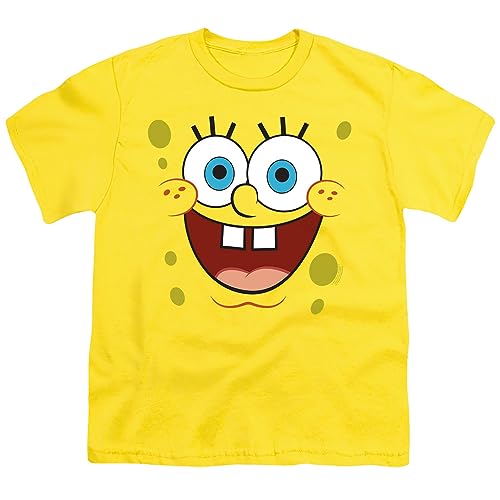
| Popfunk Spongebob Smiling Face Halloween Costume Yellow LG Popfunk Listing says “officially licensed” |
Not stated | S–4XL | PRINTED IN THE USA - Treat yourself to the unparalleled quality of our USA-printed graphic tees. Crafted in… | $17.99 checked Sep 29, 2026 |
Amazon.com · sold by Popfunk Check sizes and price on Amazon |
| Popfunk Spongebob Nerd Face Halloween Costume Yellow SM Popfunk Listing says “officially licensed” |
Not stated | S–4XL | PRINTED IN THE USA - Treat yourself to the unparalleled quality of our USA-printed graphic tees. Crafted in… | $17.99 checked Sep 29, 2026 |
Amazon.com · sold by Popfunk Check sizes and price on Amazon |
| Spongebob Squarepants The Hash Slinging Slasher Spooky SpongeBob Schwammkopf Listing says “officially licensed” |
Men, Men's Big and Tall, Women, Women's Plus, Youth, Girls | XS–6XL · 5 tall sizes · 2T–4T · 1X, 2X, 3X, 4X… | Fabric not stated Classic fit |
$19.99 checked Sep 29, 2026 |
Amazon.com Check sizes and price on Amazon |
| Popfunk Spongebob Goofy Smile Youth Halloween Costume Yellow MD Popfunk Listing says “officially licensed” |
Toddler, Youth | S–XL · 2, 3, 4, 5 | PRINTED IN USA - All designs are printed in our high-tech printing facility right here in Detroit, MI. Each… | $14.99 checked Sep 29, 2026 |
Amazon.com · sold by Popfunk Check sizes and price on Amazon |
How these shirts were chosen. We search Amazon for SpongeBob SquarePants T-shirts, keep listings that are wearable tops and clearly about this character, and order them by Amazon’s current sales rank in its clothing category — a measure of what is selling, not of quality. Sizes, fits and fabric are quoted from the listing and Amazon’s size data. We have not worn, washed or tested these shirts.
Links go to Amazon, and we earn a commission if you buy. How we work.
The big yellow face is the classic design and reads instantly. Adult fans tend to prefer a line or scene from an episode they remember, which works as an in-joke for other viewers.
See quote designs on Amazon“Best day ever” birthday shirts are a SpongeBob staple for children’s parties. They are sold by age and are best treated as a one-day shirt.
Birthday shirt advice by ageRetro designs using the early-2000s look of the show are made mainly in adult sizes and suit people who watched it first time round.
See retro designs on AmazonThese links run a live Amazon search for SpongeBob SquarePants shirts in each US size band. Amazon shows what is currently listed; availability in a particular size is confirmed on the product page, not here.
| Band | Ages | US sizes | Search |
|---|---|---|---|
| Toddler | 2–4 years | 2T, 3T, 4T | Search toddler sizes |
| Kids | 4–7 years | XS (4/5), S (6/7) | Search kids sizes |
| Youth | 8–14 years | M (8), L (10/12), XL (14/16) | Search youth sizes |
| Adult | 15+ | S–3XL | Search adult sizes |
US sizing shown. Cut and measurement vary between brands — see the size guide before ordering, especially for youth sizes. Base search: SpongeBob t-shirt.
Character guide
SpongeBob was created by a marine biologist. Stephen Hillenburg taught marine science before training in animation, and the show grew out of an educational comic he had drawn about tide-pool creatures — which is why the sea life is oddly accurate underneath the absurdity and why the character is a sea sponge rather than a kitchen sponge, despite being drawn as one. Hillenburg has said the square shape came from wanting the character to look childlike and awkward rather than cool. The series' unusual achievement is that it holds two audiences simultaneously without either being an afterthought: the surface is bright, kind and genuinely for small children, while the writing underneath is absurdist and frequently unsettling, which is why it became one of the most-quoted sources of internet reaction imagery in existence.
Nickelodeon's most commercially successful property and one of the very few children's cartoons to be adopted wholesale by adult internet culture, giving it two entirely separate merchandising audiences.
Signature motif: A yellow rectangular sponge with square trousers, a red tie and a white shirt
The rectangle is the design. A yellow square with holes reads instantly, which makes this one of the most reproducible characters in the category at any print size. The reaction-image treatments popular with older audiences are a completely separate design language from the children's apparel.
A yellow rectangle with holes reads at any size — exceptionally reproducible. Children's designs use the full character in bright colour; adult designs draw on meme and reaction imagery, which is a distinct visual language. Strong on yellow, black and white.
| Performer | Production | Year | Type |
|---|---|---|---|
| Tom Kenny | SpongeBob SquarePants | 1999 | Voice |
Some do. 7 of the 8 SpongeBob SquarePants shirts on this page are listed on Amazon in extended fits such as Men’s Big and Tall, Women’s Plus, 3XL and above, or tall sizes, according to Amazon’s size data on Sep 29, 2026. The range differs by design, so check the size menu on the product page before ordering.
Often, yes. 5 of the 8 shirts on this page were offered in both adult and children’s sizes on the same Amazon listing on Sep 29, 2026. Some of those ranges use a different design for each family member rather than one identical print, so check the design or colour menu, and order every size from the same listing.
SpongeBob SquarePants was created by Stephen Hillenburg, first appearing in SpongeBob SquarePants in 1999 (Nickelodeon).
A yellow rectangular sponge with square trousers, a red tie and a white shirt. A yellow rectangle with holes reads at any size — exceptionally reproducible. Children's designs use the full character in bright colour; adult designs draw on meme and reaction imagery, which is a distinct visual language. Strong on yellow, black and white.
Yes — SpongeBob SquarePants appears on our kids pages, and shirts are commonly made from US toddler 2T up through youth XL.
SpongeBob SquarePants has been voiced by Tom Kenny (SpongeBob SquarePants, 1999).
SpongeBob SquarePants shirts we currently track start from around $14.99 on amazon.com. Every price on this page is dated, because they move.
The character guide was compiled from published reference material about SpongeBob SquarePants and is a secondary source rather than a substitute for the original publication. Shirt details come from Amazon listings at the dates shown. We do not physically test garments; see how we work.
Reference. This profile was compiled from published sources. For the character's full publication history see Wikipedia (Wikidata Q935079). Our method and limitations are stated in full.
CharacterTshirts.com is an independent guide. It is not affiliated with, authorized by, endorsed by, or connected to any character rights holder, publisher, studio or network named on this site. All character names and titles are trademarks of their respective owners and are used here only to identify the products described.